
Flashing Directs Water Past Joints
- Roof flashing is shaped material that directs water away from roof joints, edges and openings where the covering needs a transition.
- Common locations include walls, chimneys, valleys, vent pipes, eaves and skylights, with a different detail at each junction.
- A flashing repair should address the failed piece and its connections with surrounding layers, rather than rely on a surface bead alone.
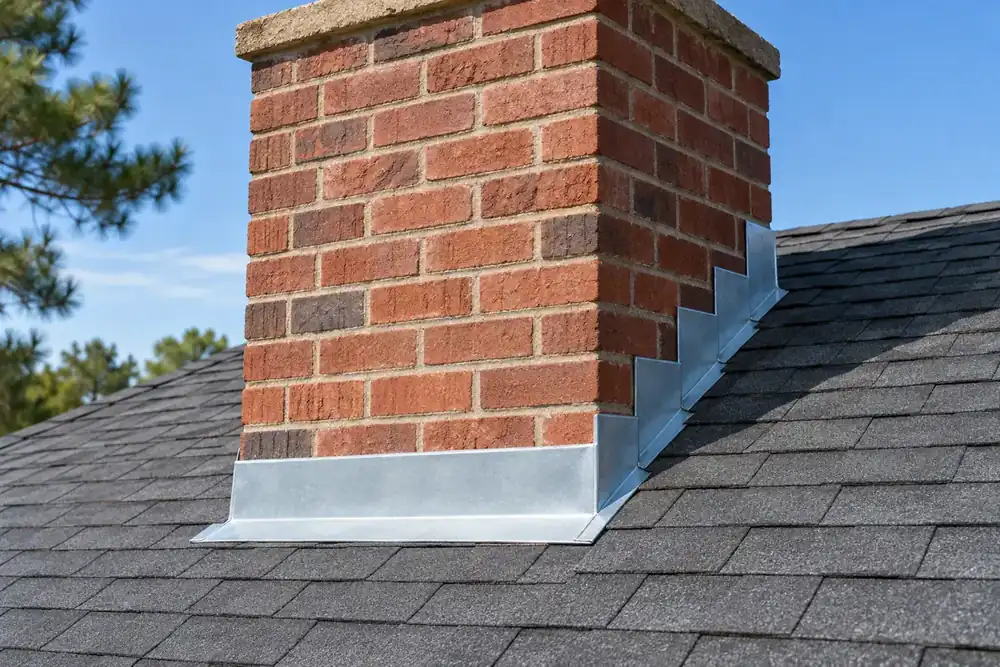
The Flashing Pieces Behind a Watertight Junction
Flashing directs water across places where roofing meets another material or an opening interrupts the roof surface. A flashing line on the scope should identify the location, the failed component and how the replacement connects with the layers around it.
- Opening the junction. Your roofer identifies how much covering or adjoining material needs removal to reach the flashing. Access behind siding or around masonry changes the work.
- Checking the backing. The wood and surrounding roof layers need inspection while the junction is exposed. Replacing metal over damaged backing leaves part of the problem unresolved.
- Selecting the flashing. The material and shape must suit the covering, adjoining surfaces and roof detail. Length, bends and the number of pieces affect that scope line.
- Restoring the connection. Flashing must meet the underlayment and covering in a sequence that drains outward. The scope should state which surrounding materials are reinstated.
- Completing the detail. Compatible fasteners, specified seals and disposal belong in the description. Your roofer explains any additional damaged area before extending the agreed work.
What Is the Flashing on a House Made From?
Flashing commonly uses shaped metal, with flexible materials incorporated into some details. Aluminum, coated steel and copper are examples; material compatibility matters at joints. A pipe boot often combines a rigid base with a flexible collar around the pipe.
What Is the Purpose of Roof Flashing at a Wall?
Wall flashing directs runoff past the roof-to-wall junction so water does not slip behind the covering. Step flashing uses overlapping pieces alongside successive shingle courses. At a chimney, the Department of Energy describes counterflashing overlapping the base and step flashing, with the upper connection integrated into the masonry.
What Is the Purpose of Flashing on a Roof With Openings?
Flashing maintains the drainage path around openings and across changes in surface. Pacific Northwest National Laboratory describes roof penetrations as potential leak points that need integrated flashing. Joints interrupt the overlapping pattern that sheds water across an uninterrupted shingle field, so they deserve close attention when a leak is traced.
The following locations need different shapes, even though the aim is the same: carry water onto the next drainage surface.
| Where it goes | What it is | Why it matters |
|---|---|---|
| Roof beside a wall | Step flashing interwoven with shingle courses | Routes runoff past the wall junction |
| Chimney base and sides | Base and step flashing covered by counterflashing | Joins the roof drainage layers to masonry |
| Open valley between slopes | Formed valley metal beneath adjoining covering | Carries concentrated runoff down the channel |
| Vent pipe | A boot or collar fitted around the pipe | Closes the transition around a roof opening |
| Eave edge | A bent metal drip edge | Directs runoff away from the deck edge |
| Skylight perimeter | A kit matched to the skylight and roofing | Connects the frame with the surrounding covering |
Pacific Northwest National Laboratory describes the drainage roles of valley metal and drip edge, including directing edge runoff toward the gutter.
What Is Flashing on a Roof Showing From the Ground?
Visible flashing may look like a narrow metal edge, stepped pieces or a band around a chimney. Rust streaks, displaced metal or an obvious gap in an exposed seal can justify inspection, but distance limits what you can identify. A stain below a chimney also helps locate the concern without proving which joint failed.
What Is Roof Flashing Repair Supposed to Include?
Flashing repair should restore the failed transition and its connection to sound surrounding materials. To repair flashing on a roof, your roofer may need to remove neighboring shingles and replace concealed pieces. Flashing repair on a roof with damaged backing also needs a separate description of that backing work. A surface seal alone does not recreate missing overlaps.
What Is Synthetic Roof Underlayment Doing Beneath Shingles?
Synthetic underlayment is a manufactured sheet beneath the covering that provides an additional water-shedding layer over the deck. The National Roofing Contractors Association's Professional Roofing magazine describes synthetic alternatives to asphalt felt made with polymer resins such as polyethylene and polypropylene. Underlayment and flashing meet within the assembly; neither replaces the need for the other.
Call about the leak or visible gap, and a local roofing professional in our network will talk through the repair scope and price before work begins. The roof leak repair page describes tracing water to its entry point.
Keep observations at ground level or indoors; leave roof access and ladder work to your roofer. Never attempt to reseal a roof joint yourself. If safe, catch a drip in a bucket and move nearby belongings. Stay away from a ceiling that bows or sags, and leave a light switch off if water is near its fixture. Photos from a safe location can accompany the description you give on the call.